3.9.2026
A driving range built from scaffolding – how Tapiola Golf got its new covered driving range
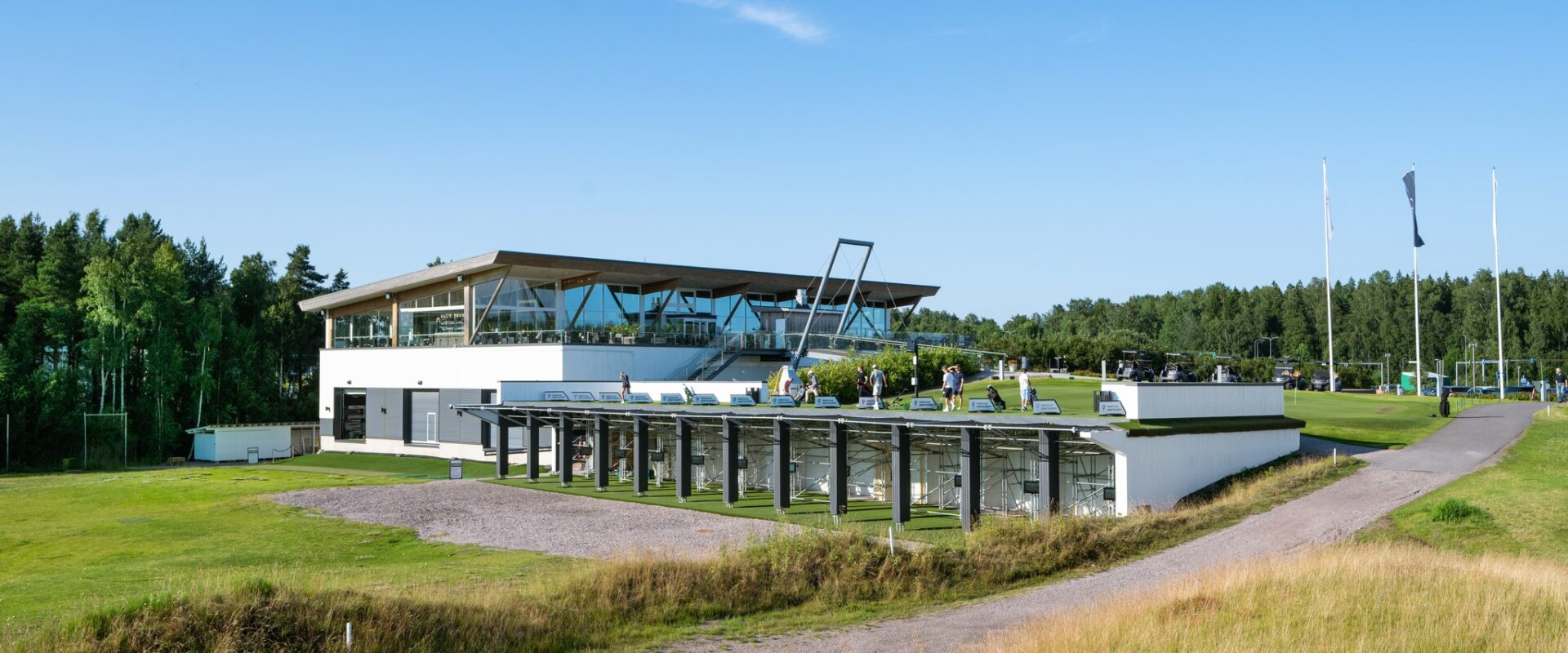
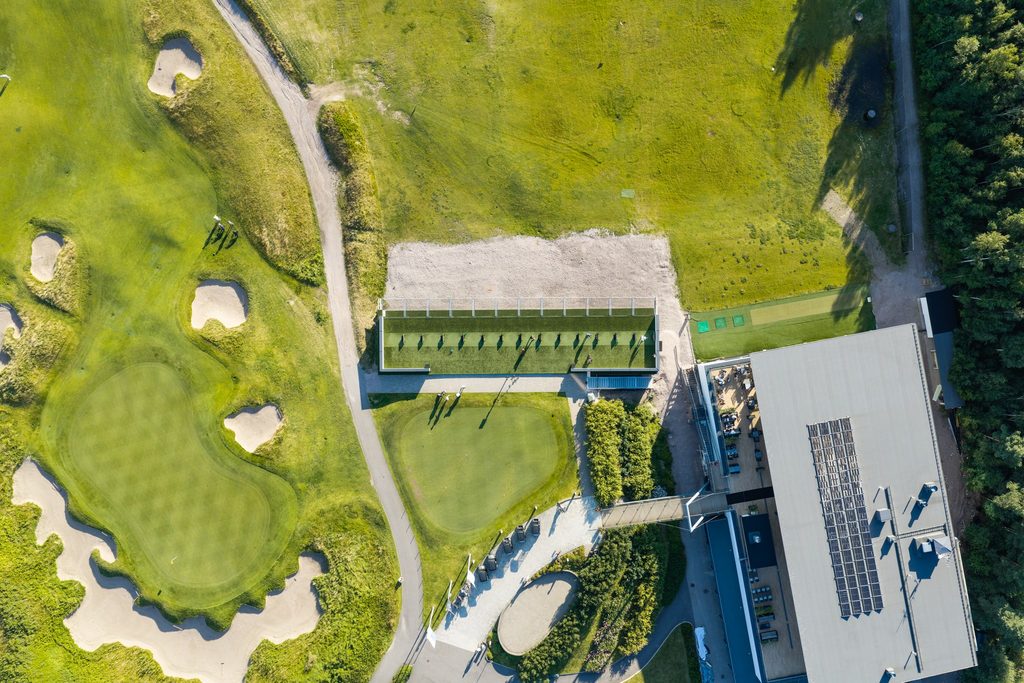
A two-storey, 40-metre covered driving range built entirely from standard ALFIX modular scaffolding components. The solution is light, adjustable and went up quickly.
When Tapiola Golf needed a new covered driving range on difficult ground conditions, the answer came from an unexpected direction: a scaffolding system familiar from construction sites, this time built as a permanent structure designed for public use.
The old driving range had reached the end of its life
Tapiola Golf is a high-quality golf centre and an active golf community in the heart of Espoo, offering a wide range of golf services. The covered driving range at the centre had aged, and the ground beneath it had settled in places. Renewal was due, but the conditions were demanding: play could not be interrupted mid-season, and the new structure had to work on difficult ground.
Jari Hakkarainen, Managing Director of Tapiola Golf, began mapping out the options together with construction specialists MaxBuild Oy. MaxBuild Oy provides project management, consulting and building services engineering for construction projects, and took on the project management role here as well.
The question that changed the project’s direction
Kristo Herold, Managing Director of MaxBuild, says the idea for this unusual solution first came up around two years ago. The thought arose of whether a scaffolding system might adapt to a structure like this: “I asked Peter at Suomi Teline whether this could work – whether the scaffolding could be permanent rather than temporary,” Herold recalls. When Peter Korhonen, Managing Director of Suomi Teline, answered yes, the project moved ahead through tendering, design management and the permit process.
ALFIX, the German manufacturer of high-quality scaffolding, joined the project as a natural partner. Managing Director Andreas Meier says ALFIX is actively looking for projects like this one: “It’s very interesting and always a surprise what is possible with scaffolding material.”
The ground moves – but the scaffolding adjusts with it
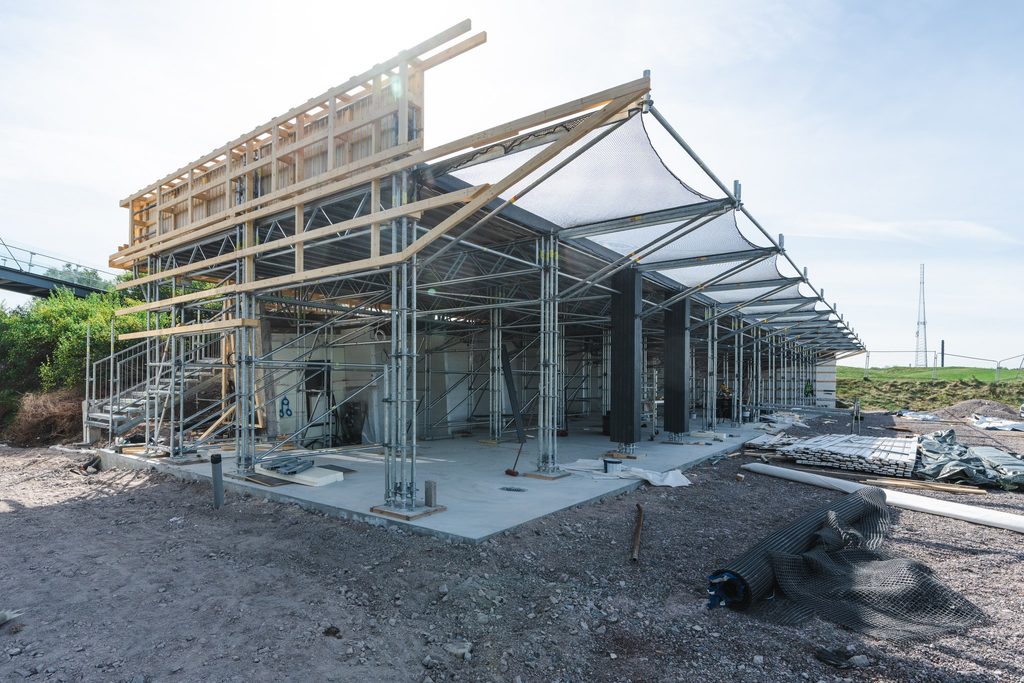
The hardest part of the project was neither the dimensions nor the loads, but the ground. “The clay and soil structures in the area settle. The ball machine causes constant vibration, and the massive structures built at the time only added to the settling. We started from a blank sheet, working out how to build a driving range in a place where one side is stable and the other is sinking,” Herold explains.
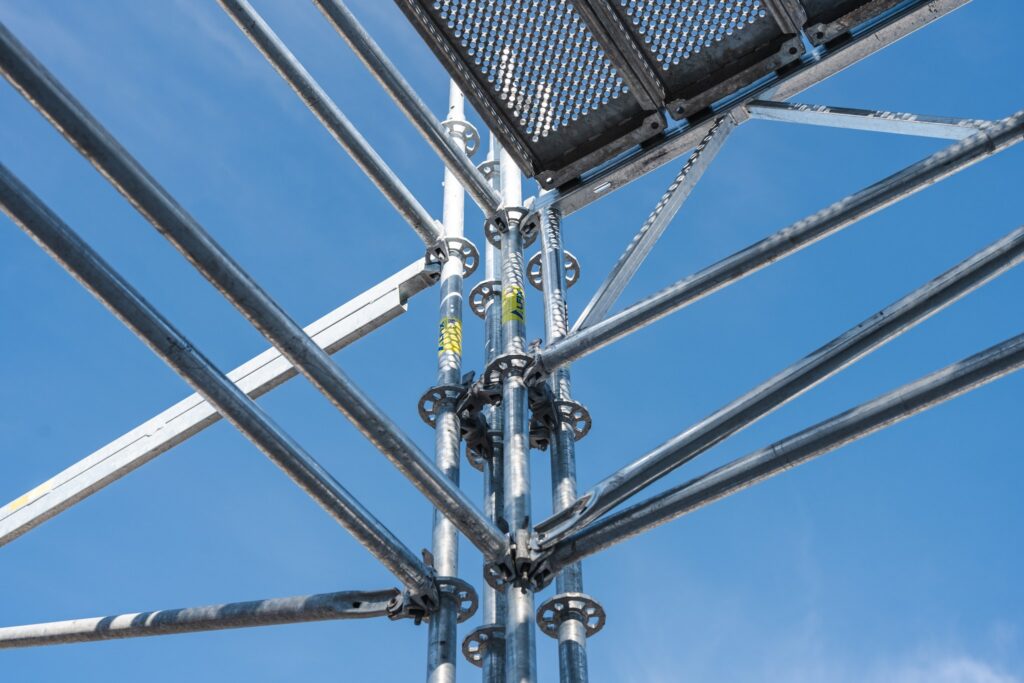
The answer turned out to be a feature built into the scaffolding system itself: “The answer is simple: adjustability. The structure is monitored continuously, and a full adjustment is made every year when the season opens,” Herold says.
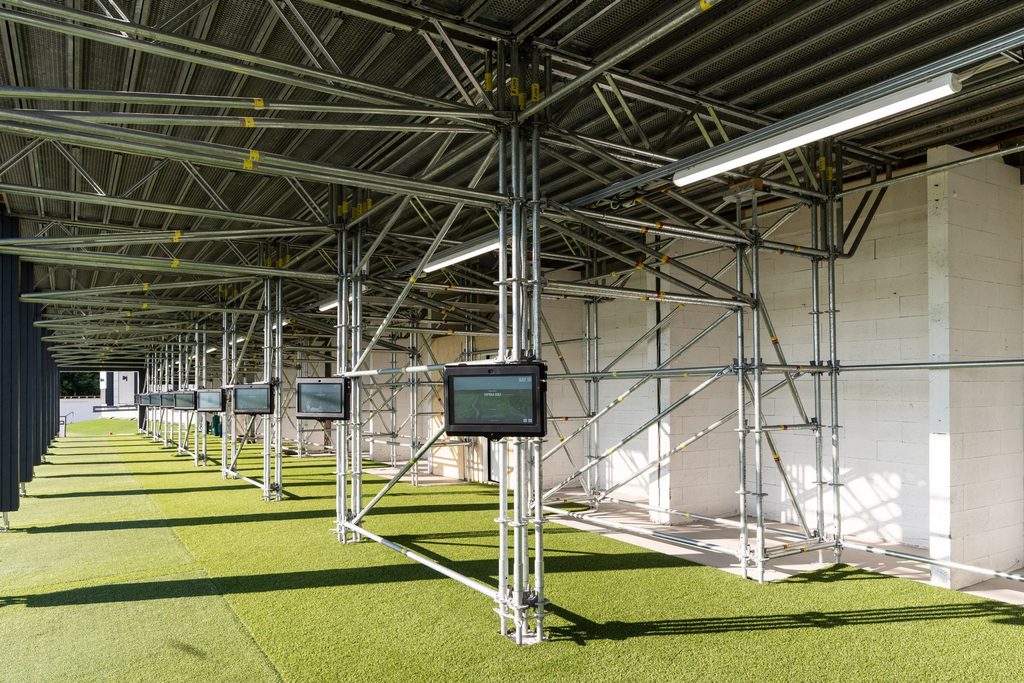
It is also worth noting that no custom-made parts were needed, as the entire structure stayed within the system’s standard dimensions.
The bay dimensions were worked out through several trial assemblies, so that the result would also work from the player’s point of view. “There is no point building a fine platform or building that doesn’t work in practice,” Herold notes.
Cladding finished the job
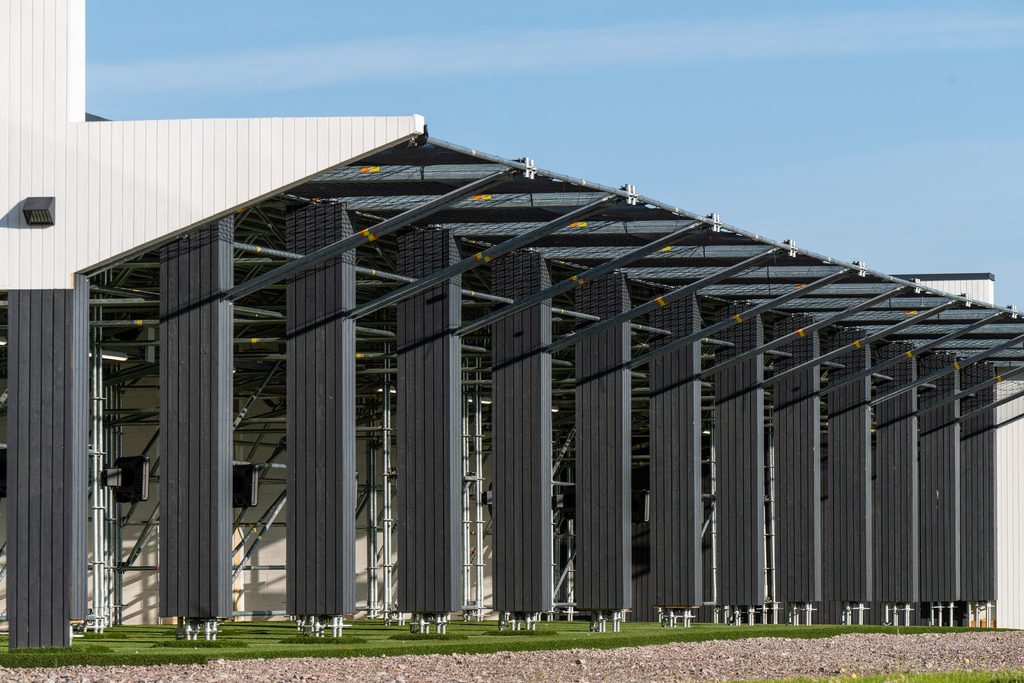
The completed structure offers 27 bays and practice places across two storeys, safely designed for public use and clad so that the result looks like a finished building – not scaffolding.
Ground settlement was taken into account in the cladding too: it was designed from the outset to be adjustable, so that adjusting the frame does not damage the outer surface. A fixed structure would not have allowed the same.
Hakkarainen considers the outcome a success: “We are pleased with the result, it’s rather stylish!” He says users have found the upper floor particularly good.
Building control approved it without remarks
The biggest doubt beforehand was not about the technology, but about how building control would view the project – and whether the system would be accepted as a permanent structure. In the Helsinki metropolitan area, the project went through a full building permit process, which is fairly demanding. Since the structure is not fixed, Herold suspects the permit process could be more straightforward in some municipalities.
Herold says ALFIX’s technical experts provided answers, calculations and structural dimensions for every question. “They raised hardly any questions at building control – the answers were thorough and professional.”
The structure was taken into use at the beginning of June. “A zero-defect handover – building control had practically nothing to remark on,” Herold says with satisfaction.
Service life and maintenance of a permanent scaffolding structure
Scaffolding is typically used for temporary solutions, but in this project the structure was built to stay. That raises the question of durability.
Asked how durable a structure like this really is, Meier says: “Scaffoldings are made for a long time to stay and actually we expect the delivered material will give fun some decades. However the customer should employ the scaffolding company one time a year to check all connections. That needs just a couple of hours but makes sense in my view.”
A scaffolding solution that scales to any size of need
The same solution can be built at a fraction of the size – and it is no more demanding technically. Four bays work just as well as twenty-six. The difference is in the number of parts, not the technology.
“Regarding the technical view the length of the construction doesn’t change anything for the statical calculations. So the measurement of the construction should be a decision regarding the amount of club members. ALFIX gonna assist in every case. Doesn’t matter if longer or shorter,” Meier promises.
The economics support the solution too, and the point of comparison comes from an unexpected place: “Depending on the ground conditions, the foundation work alone could have cost more than this entire structure,” Herold estimates.
A practice area also generates income. At Tapiola the bays are rented out and occupancy has been high – which makes the investment worth considering for a smaller club as well.
Hakkarainen raises another interesting angle on investing in scaffolding: “If it turned out in the long run that the solution doesn’t work for us, we could dismantle the structure and sell the scaffolding on. That isn’t possible with other structures.”
Four partners, a short decision chain
Tapiola Golf placed the order, MaxBuild handled project management, construction work and cladding, Suomi Teline the scaffolding work and ALFIX delivery, and ALFIX’s technical team the design and structural calculations.
“The project was very straightforward, because the decision chain was so short. The club’s representative worked closely with us on a daily basis, and Suomi Teline had someone involved throughout. Decisions were made very quickly,” Herold says. He adds that the same applied to changes during construction, which are inevitable in a project like this: “ALFIX’s experts assessed how the changes affected the calculations and we got the answers very quickly. When you need a decision today rather than tomorrow, it works.”
Meier’s message to the project team sums up the character of the project and its outcome well:
“I will say thanks to the end customer Tapiola golf club for the trust, our partner Suomi Teline with Peter Korhonen and the company MaxBuild with Kristo Herold for the great collaboration which made the project to that success. Also thanks to our technical team at ALFIX which took care about planning, statical planning and drawings as well.”
How to get a similar project started
Hakkarainen says the driving range has attracted interest not only among golfers but also among others in the industry. We asked those involved what advice they would give to clubs considering a similar project. The following steps made the checklist:
- Get the background information, ground data and needs assessment in order
- Talk to your municipality’s building control and to architects
- Set the objectives in writing to make sure everyone involved shares the same understanding
- Ask Suomi Teline for a preliminary calculation to take to building control
Another lesson from the project was that the scaffolding system itself goes up quickly – in this case in about five weeks. Most of the time went into the other stages, such as the permit process.
Scaffolding can do more than you would expect
Permanent scaffolding structures are rare worldwide. Meier recalls only a handful, such as a seated grandstand in a football stadium. For him, Tapiola Golf’s driving range is exactly the kind of project that shows what a scaffolding system can do. It proves in practice an idea he believes in strongly: “I have been there at Espoo as the first planning started. I like this project so much and I love the final result! A perfect sample for my theory: everything is possible with scaffolding material.”
Is your club facing a renewal of its bays or an expansion of its practice area? Tell us what you need and we’ll work out together what size of solution fits.